"Foolish, superstitious, ethnical, and idolatrous"
Richard Garrard investigates William Prynne’s Canterburies doome (1646), examining his inquisition into Laud’s “popish” furnishings and considering how it might inform the ritual of our forthcoming ‘Laudian’ Mattins and Litany according to the 1559 Book of Common Prayer, the last in our series charting the development of the English church during the Reformation (21st Nov, 11am, St Bartholomew the Great, London)
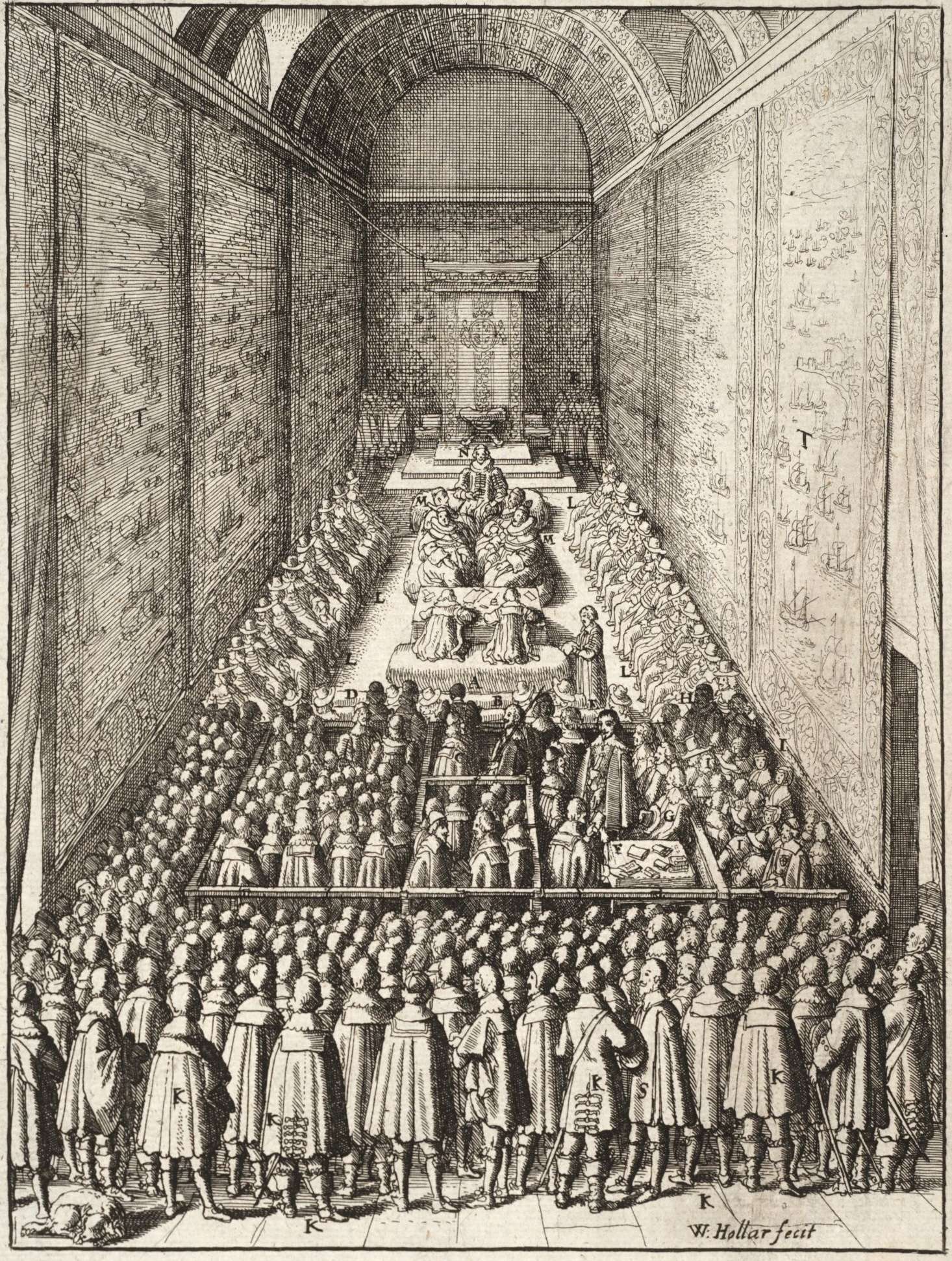
In preparation for the service of ‘Laudian’ Mattins and Litany, many of those taking part have been busily engaged in researching the eccentricities of High Church liturgical styles of the 17th century. A particularly important history of these High Church practices can be found bound within a peculiar tome produced by the Puritan lawyer and agitator, William Prynne, Canterburies doome. Printed in 1646, the book served as a complete record for the parliamentary procedures, evidences, and arguments presented for the condemnation of Archbishop William Laud. Prynne presents a picture of Laud as the arch-villain of the religious tumult of Personal Rule, attempting to usher in popery in all aspects of the Church’s doctrine and liturgy. Prynne’s fascinating history of the trial does not only present the events of the 1644 trial, which eventually led to Laud’s execution on 10th January 1645 (n.d.), but also many background documents which give us a unique insight into High Church liturgical practices. Whilst describing Laud’s consecration of churches as Bishop of London, Prynne highlights the connection between Laud and Lancelot Andrewes in the construction of their private chapels. The private chapel of Andrewes is shown pictorially through a copper engraving, with references and an inventory of what was found in it. Here is the image and the description which Prynne affixes to it:
An extract from Canterburies doome (1646)
Chapel and furniture as it was in use by the Right Reverend Father in God, Lancelot Andrews, Lord Bishop of Winton: from whom the Archbishop confessed at the bar, he took his pattern of consecrating and furnishing churches, chapels, and altars. By which two papers publicly read and shewed in the Lord’s house, the Popish furniture both of Bishop Andrews’ and this Archbishop’s chapels at Aberguilly, London-house, and Lambeth, will most evidently appear to all the world. The portraiture of the first of these two papers, with the Popish furniture of the altar in the Archbishop’s and Bishop Andrews’ chapels, is expressed to the life in the following copper piece.
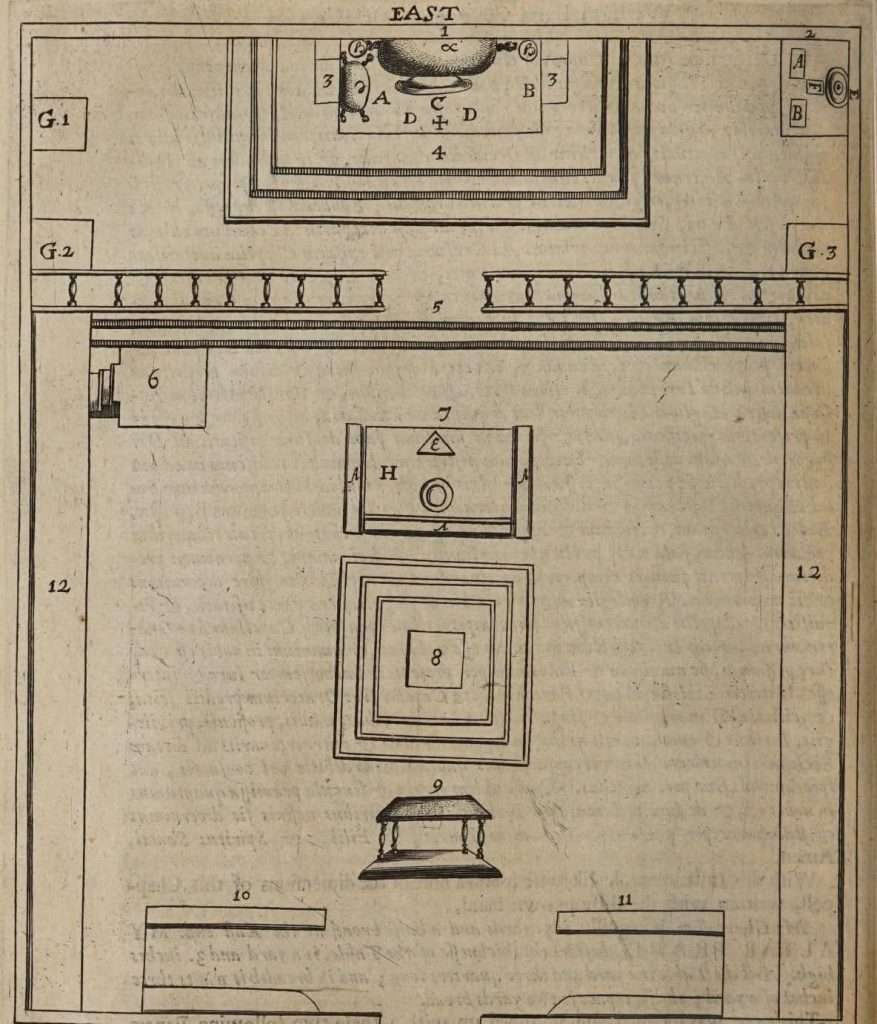
Plate (copper engraving) depicting Lancelot Andrewes' private chapel as found in William Prynne’s Canterburies doome (1646)
[Contents]
1. The Altar, 1 yard ¼ high, 1 yard ¾ long, 1 yard broad.
α. A cushion.
ββ. Two candlesticks, with tapers.
γ. The bason for oblations.
δ. A cushion for the service book.
A. The silver and gilt canister for the wafers, like a wicker basket and lined with cambric laced.
B. The Tonne, upon a cradle.
C. The chalice, having on the outside of the bowl Christ with the lost sheep on his shoulders; on the top of the cover, the wisemen’s star, both engraven; it is covered with a linen napkin (called the Aire) embroidered with coloured silks.
DD. Two patens.
✠ The Tricanale, being a round ball with a screw cover, whereout issue 3 pipes, and is for the water mixture.
2. A sier table on which, before the Communion, stand A and B, upon two napkins.
E. A bason and ewer, to wash before consecration.
F. The towel appertaining.
3. The kneeling-stools covered and stuffed.
4. The foot-pace, with three ascents covered with a Turkey carpet, of fir boards.
GGG. Three chairs used at Ordinations, or prelates communicant.
5. The septum, with two ascents.
6. The pulpit.
7. The music table with (AAA) three forms.
ε A Triquertral censer wherein the clerk putteth frankincense at the reading of the first lesson.
H. The Navicula, like the keel of a boat, with a half cover and a foot out of which the frankincense is poured.
8. A foot-pace with three ascents, on which the lectern standeth covered, and thereon the great Bible.
9 .The faldstory whereat they kneel to read the Litany.
10. The chaplain’s seat where he readeth service.
11. A seat with a canopy over it for the Bishop; but at the Communion time he sits on G3.
12. Two long forms for the family.
Lo here in this piece and chapel, you have first an altar; secondly, strange Popish furniture on this altar; viz. two silver candlesticks with tapers in them, (expressly prohibited by Queen Elizabeth’s Injunctions, anno 1559, Injunct. 3, 23, which prohibit setting up of candles; ordering all candlesticks, trindals, and rolls of wax to be taken away and extinct, as monuments of superstition and idolatry; by the Homily against the peril of idolatry, part 3, pp. 50, 51, which condemns the use of tapers and candle religion, as foolish, superstitious, ethnical, and idolatrous; and generally censured by all our orthodox writers, as popish and heathenish). A bason for oblations. A silver and gilt canister¹ for wafers. A chalice, with the picture of Christ engraven on it. An aire. A tricanale or pot with three pipes for the water of mixture (that is, for water to mix with the wine, and for holy-water). A credence or side table. A bason and ewer (for the polluted priests and prelates to wash in before consecration), and a towel to wipe their unhallowed fingers. A censer, to burn incense in, at the reading of the first lesson, as in the Popish mass and churches. A little boat out of which the frankincense is poured, &c. (which Dr. Cosins had made use of in Peter-house, where he burned incense). Furniture directly borrowed from the Roman Ceremonial, Missal, and Pontifical, nowhere to be found but in Popish chapels and churches. You may judge of this prelate’s chapel and Popish inclination, by this Romish furniture thereto belonging; and that mentioned in the next ensuing, being an inventory of his chapel furniture and plate, found with the former, attested by Master Prynn.
Furniture belonging to the Chapel
Behind the Altar: a piece of hangings 11 feet deep, and 5 yards ¾ long. Another piece of hangings. The story of Abraham and Melchisedec; part of the story of David.
A Table, with a frame of deal, used for the Altar, 1 yard ¼ high, 1 yard ¾ long, 1 yard broad. A back-piece of crimson and violet damask paned, 1 yard ½ deep, 3 yards long.
A front-piece of the like, 1 yard ¼ deep, 3 yards long.
A pall of violet damask, 1 yard ¼ broad, 3 yards ¼ long.
A cushion of violet and crimson damask, ½ yard broad, 1 yard long.
A rail of wainscot banisters before the Altar.
Two traverses of taffeta crimson and velvet paned, 3 yards ¼ deep, yards ¾ broad.
A foot-pace with two ascents of deal, underneath the Altar, 3 yards long, 1 yard ¾ ⅛ broad.
A Turkey carpet to it 4 yards ¾ long, 2 yards ¼ ⅛ wide.
Two low stools to kneel on at each end of the Altar, stuffed and covered with purple baise.
A square pulpit of wainscot, 1 yard ¾ high, 1 yard square.
A pulpit cloth of crimson and violet damas paned, 1 yard ¼ deep, 3 yards long.
A music table of deal.
Three forms to it, covered with purple baise.
A carpet of purple broad-cloth, 3 yards long.
A carpet of purple baise, 3 yards long and ¾ broad.
A foot-pace of three ascents, 2 yards ½ square, and thereupon a lectern with the great Bible.
A cloth to the lectern of purple broad-cloth, 3 yards long.
Another of purple baise, 3 yards long, 1 yard ¾ broad.
A faldstory of wainscot, 1 yard 1 nail high, 1 yard lacking a nail broad at top; 1 yard lacking two nails breadth below.
A cloth to it of purple broad-cloth, 2 yards ¾ long, 1 yard ½ broad.
Another of purple baise, 2 yards ¾ long, 1 yard ¼ broad.
Over the Bishop’s seat.
A canopy of crimson and violet damask paned, 2 yards ¼ ⅛ long, 2 breadth.
The valence to it, 3 yards compass ¼ ⅛ deep.
A cushion to it of violet damask, 1 yard long, ½ ⅛ yards broad.
A folding table of wainscot near the Altar.
A carpet of baise on it, 1 yard ½ wide, 1 yard ½ long.
Four folding chairs of leather.
Plate for the Chapel.
- s. d.
Two candlesticks, gilt, for tapers 60 oz. at 5 6 the oz.
A round bason for offerings, gilt and chased, 31 ½ ,, 6 8 ,,
A round bason for alms, gilt and chased, 30 ,, 6 0 ,,
An oval bason and ewer, gilt and chased, 51 ,, 6 0 ,,
Two patens, gilt, 36 ,, 10 0 ,,
For cutting the figure, 13s. 4d.
A chalice and cover, gilt, 43 ,, 10 0 ,,
For making the star on the chalice, 3s
A tun, gilt, 47 oz. 3 dwt. 6 11 ,,
A cradle to it, gilt, 18 ¾ oz. at 6 11 ,,
A funnel to it, gilt, 3 ,, 6 11 ,,
A canister, gilt, 5 ¾ ,, 10 0 ,,
A triquertral censer, 85 lack 6 dwt. 7 0
For gilding it, at 16d. the ounce.
A laten pan for it, 5 0 ,,
For making the knob of it 2 0 ,,
A crewet, gilt, with three spouts, 10 oz.½ ⅛ dwt. 7 9 the oz.
Another, gilt, with a bird’s bill, 4 less 5,, 6 8 ,,
Five copes.
Five surplices.
Two Altar-cloths.
Two towels thereto.
A cloth to lay over the chalice, wrought with coloured silk, called the Aire.
For Prynne, a hardened Puritan, much of this furniture has a distinctly ‘popish’ sensibility. Andrewes has tried to accomplish a particularly syncretic style of both traditional and Early Modern features throughout the Chapel, which would have been deeply offensive to a ‘plain’ style of worship. Candlesticks on the altar, specifically with tapers (perhaps for lighting), would have been deeply offensive to Puritan sensibilities. Not only was this associated with pagan of popish “candle religion” (as the Homily on Peril of Idolatry would say), but it also framed the altar in a way so as to draw it to the eye as the central feature of the Chapel (something Laud would do with his altar policy as Archbishop of Canterbury). Moreover, Andrewes’ use of images on the chalice would have caused offense both as a Second Commandment violation (in the eyes of the Puritans) and as implying the real presence of Christ in the Eucharist. Whilst engraved metals was not unknown in this period, it would only be after the Restoration in 1660 that sacred vessels of engraved silver would become more acceptable, as is seen in the Restoration basin from St. George’s Chapel, Windsor depicting the Mandatum. 1
Prynne also lists a ‘Tricanale’ which would have been used for the commixture of water into the wine at the Eucharist. Andrewes was famous for restoring this eucharistic practice, abolished by omission in the 1552 Book of Common Prayer, as Dean of the Chapel Royal. This ‘Tricanale’ was accompanied by a bason and ewer (as listed in Point 2) which would have been for the ablution of the hands, as well as the sacred vessels themselves. One of the most fascinating items which is listed by Prynne is the so-called ‘Triquertral censer’, which would have been a triangular bowl wherein coals were lit and incense was burned. This likely reflected the shape of many censers from before the Reformation, but unlike those which were on chains, it appears that Andrewes’ chapel had a stationary censer. The use of incense in worship had never been universally banned rubrically or by Injunction in the Church of England and there are a number of notable examples of its usage all the way up until the 18th century. 2 Such furniture and practices implies a wholehearted return to many of the pre-Reformation norms of English religion, but with an eye to preserve many of the Reformed practices (such as the use of the Book of Common Prayer) and integrate them together to create a holy and beautiful worship.
As is given in Prynne’s description below his inventory, the Puritans believed this was a rank return to a form of ‘Popery’ that was intolerable for a reformed Church. Prynne also recognises that Andrewes’ Chapel sits in a tradition of various High Church characters, such as John Cosin whose term as Master of Peterhouse saw the introduction of further ceremonialism, encouraged by the example of his predecessor Matthew Wren.
Moreover, the actual architecture of the Chapel suggests a return to traditional forms of worship. Whilst Laud had attempted to restore the position of altars to their original positions (with a good deal of success) during his term as Archbishop of Canterbury, newly designed churches would sometimes be built with intentional medieval features. This is certainly true for Andrewes, whose footpaces had the traditional three steps around the position of the altar imitated the steps for the Sacred Ministers used at a pre-Reformation High Mass. Even the use of rich fabrics, such as damasks (which Prynne lists), on seats and reading lecterns, all point towards an adornment which sought to return to the beauty of pre-Reformation religion whilst not destroying the integrity of Andrewes’ understanding of the Reformed settlement. The use of characterful wall hangings would have too been offensive to Prynne as the depiction of Melchizedek near the altar would have indicated a connection between Old Testament sacrifices and ritual with the performance of the Holy Eucharist of the New Covenant.
This list could go on for how offensive all this was to Prynne, but it seems fairly self-evident how antithetical to Puritan sensibilities Andrewes’ own liturgical and architectural taste was. Prynne gives us a fascinating insight into eccentric traditions of Anglican worship and an appreciation of how Anglican High Churchmanship attempted to work out its character through liturgical exegesis. Some of the ceremonial and furniture described by Prynne here will be used at our Laudian service and I do encourage you to look out for it on 21st November!